2026 Best Foam Magnetic Blocks for Global Buyers
Choosing the right Foam Magnetic Blocks in 2026 requires more than comparing colors, prices, and piece counts. Global buyers need dependable materials, strong magnets, accurate product information, and practical packaging. A classroom set may face daily handling, while a retail kit may travel through humid warehouses and crowded distribution centers. Small details matter.
This guide examines leading options through a buyer’s perspective. It considers magnetic connection strength, foam density, edge finishing, shape variety, cleaning requirements, age guidance, and supplier communication. It also highlights evidence that serious purchasers should request, including material specifications, batch details, inspection records, and applicable safety documentation. Requirements can differ between markets. Always verify them before placing an order.
Real testing remains valuable. Build a bridge, twist a joint, and drop a block onto a clean table. Watch how quickly the pieces reconnect. Check whether surfaces keep their shape after repeated use. Ask whether replacement pieces are available. Ask clearly.
No ranking is perfect. Product performance may change between batches, and attractive photographs can hide weak seams or limited documentation. A lower price may also reflect simpler packaging rather than poor quality. That point deserves careful review. Reliable sourcing depends on transparent communication, realistic lead times, and written specifications. Buyers should compare samples with final production units whenever possible. This introduction sets a practical foundation for evaluating the best Foam Magnetic Blocks for global classrooms, retailers, distributors, and family-learning markets in 2026.
What Are Foam Magnetic Blocks and How Do They Work?
2026 Best Foam Magnetic Blocks for Global Buyers
What Are Foam Magnetic Blocks and How Do They Work?
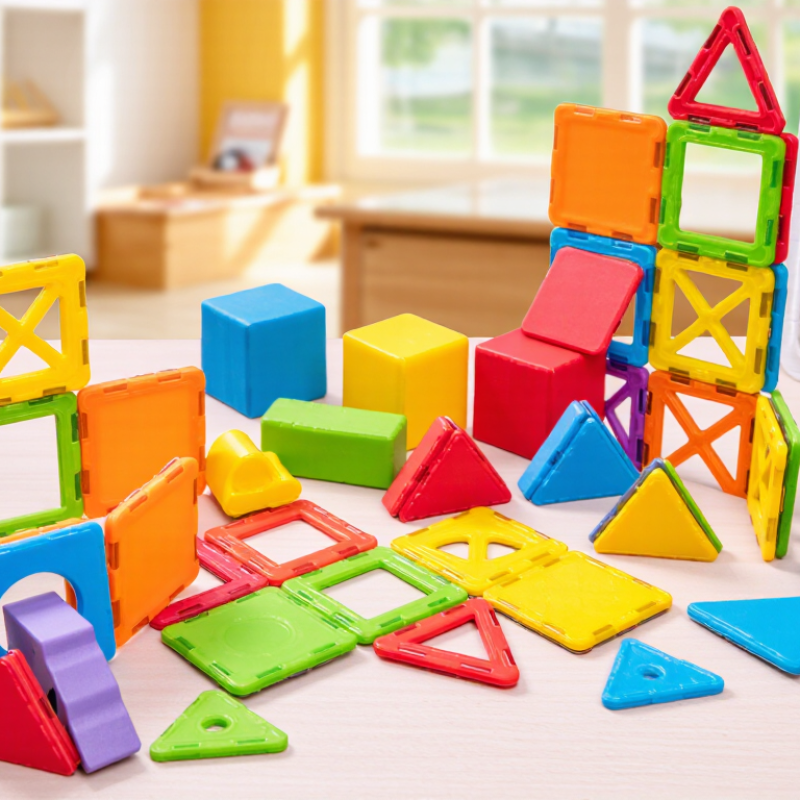
Foam magnetic blocks are lightweight construction pieces made from soft, resilient foam with magnets sealed inside. Their surfaces feel warm and slightly cushioned, unlike hard plastic or wooden blocks. The magnets attract through internal connector points, allowing blocks to join, separate, and rotate with moderate force. A child can build a small bridge on a table, then lift it without the structure immediately collapsing. This simple action explains the core mechanism: magnetic attraction holds aligned pieces together, while foam provides shape, grip, and impact protection.
Each block needs carefully positioned magnets. Opposite poles must face correctly, or a piece may repel instead of connect. Good engineering also keeps magnets enclosed, reduces sharp edges, and maintains consistent dimensions. Buyers should examine age guidance, seam quality, magnet security, cleaning instructions, and test reports from recognized laboratories. These details matter more than bright colors. For global purchasing, check packaging language, material declarations, and product safety requirements in the destination market. Standards differ.
Foam magnetic blocks support open-ended building rather than one fixed result. Children can create towers, animals, road layouts, or uneven shapes that reveal balance problems. In repeated hands-on play, users often find that softer pieces encourage rebuilding after a tower bends. That small failure is useful. Still, foam is not indestructible; compression, heat, moisture, and rough storage can weaken its surface or internal bonding.
Key Features and Benefits for Different Age Groups
2026 Best Foam Magnetic Blocks for Global Buyers
For toddlers aged three to five, foam magnetic blocks should feel light, soft, and easy to connect. Large pieces support safer handling and reduce frustration during early building. Buyers should check that magnets are fully sealed inside each block. Exposed magnets can create serious risks if swallowed. Bright colors also help children name shapes, match pieces, and develop simple sorting skills.
Children aged six to eight need more challenge. Stronger magnetic connections can support towers, bridges, animals, and small imaginative scenes. Different geometric shapes encourage planning and basic spatial reasoning. For older children, blocks with varied angles and stable edges can introduce balance, symmetry, and early engineering concepts. However, magnetic strength is not everything. A very strong connection may make rebuilding difficult for younger users. This is an easy detail to overlook.
Tips: Choose age-labeled sets with clear safety information. Confirm material testing for the destination market. Inspect seams, corners, and magnet covers before each use. A damp cloth usually works better than harsh cleaners. Store pieces in a dry container. Supervise younger children, even when the product looks durable. Product photos can be misleading, so request actual dimensions and package details from the supplier. Foam may also compress after heavy use, so buyers should ask about density and replacement options.
Safety Standards and Quality Checks for Global Buyers
2026 Best Foam Magnetic Blocks for Global Buyers
Safety begins with the magnets, not the colorful foam. Each magnet should remain fully enclosed after pulling, twisting, compression, and repeated drops. Testing should consider EN 71, ASTM F963, and ISO 8124 requirements for the destination market. These standards address magnet safety, physical properties, flammability, and chemical migration. Compliance documents must match the actual product, factory, and production batch. A generic certificate is not enough.
Practical quality checks should examine foam density, edge bonding, surface cracks, odor, dimensions, and color consistency. Inspectors can cut sample pieces to verify magnet placement, but this destroys the sample. That limitation matters. A clean appearance can hide weak internal bonding. I would also request reports for phthalates, heavy metals, and other restricted substances. Packaging deserves attention too. Small loose parts, warnings, age grading, and language requirements must suit each market. Details are easy to miss.
Tips: Order pre-production samples and test them with realistic handling. Check magnet retention after drops and compression. Keep batch photos, inspection records, and test reports together. Ask for corrective action when results are unclear. Cheap foam can become expensive after recalls, delays, or customer complaints. Safety is not a one-time document. It needs repeated verification.
2026 Best Foam Magnetic Blocks for Global Buyers - Safety Standards and Quality Checks for Global Buyers
Selected U.S. toy chemical limits commonly reviewed during global sourcing. Lower values indicate stricter limits. Buyers should also verify magnet retention, small-parts, flammability, mechanical, labeling, and traceability requirements in the destination market.
Reference values: 90 ppm lead in paint or surface coatings and 100 ppm total lead content in accessible toy substrates under U.S. CPSIA requirements; 1,000 ppm for each regulated phthalate in covered children's toys. These figures are reference limits, not a complete product-certification specification.
How to Compare Materials, Designs, and Product Specifications
2026 Best Foam Magnetic Blocks for Global Buyers
How to Compare Materials, Designs, and Product Specifications
Material quality affects play, durability, and buyer confidence. EVA foam feels softer, while EPE foam usually weighs less. Press a sample firmly and check its recovery after one minute. A strong chemical odor is a warning sign. Ask for density data, surface hardness, and independent test reports. I have seen attractive samples crumble around the magnet pocket. Photos did not reveal that weakness.
Design details deserve equal attention. Large blocks suit younger children, but they may limit complex models. Check edge rounding, block thickness, and connector placement. Magnets should remain fully enclosed after repeated bending and drop tests. Test a sample on a wooden floor, not only on a showroom table. Polarity must stay consistent across every piece. One confusing connection can frustrate a child quickly.
Specifications help global buyers compare offers accurately. Record each block’s length, width, weight, magnet type, quantity, and dimensional tolerance. Confirm packaging size before estimating freight costs. Also request age guidance, material declarations, and laboratory reports for the destination market. Documentation can be incomplete. That is a real purchasing risk. Do not rely on a supplier’s spreadsheet alone; compare samples with production units and inspect random cartons before shipment.
Sourcing, Customization, Pricing, and Shipping Considerations
For global buyers, foam magnetic blocks should be sourced through a documented supplier, not a catalog image. Request material specifications, magnet strength, edge finish, and batch records. Ask for samples from the planned production line. A perfect sample proves little. Check odor, compression recovery, loose magnets, and connector fit after repeated assembly. Keep records. Test it. Children may chew components, so age grading, warning labels, and applicable toy-safety testing must match the destination market. Requirements differ by country, and assumptions create expensive delays.
Customization can cover colors, shapes, surface texture, packaging, and learning cards. Confirm the smallest custom detail before tooling. A two-millimeter logo change may alter mold cost. Use digital drawings with tolerances, approved color references, and a signed preproduction sample. Custom inserts often raise carton dimensions. That affects freight more than expected. I would avoid ordering too many variations early. Buyers sometimes design an impressive set that is difficult to pack or explain. Simpler assortments may sell better, though this should be tested rather than assumed.
Pricing should be compared on landed cost, not unit price alone. Include tooling, inspection, packaging, inland transport, freight, insurance, duties, and destination handling. Request quotations at several quantities, such as 500, 2,000, and 5,000 sets. Shipping by sea usually lowers cost per unit but requires longer planning. Air freight suits urgent samples, not heavy launches. Confirm carton strength, pallet limits, HS classification, and delivery terms in writing. Build a buffer for port congestion and seasonal capacity. Plan carefully. Missing one document can stop a shipment.