7 Tips for Buying Aluminized Steel Coil
Buying an Aluminized Steel Coil requires more than comparing prices on a supplier’s spreadsheet. The shiny surface may look uniform, yet coating weight, substrate grade, thickness tolerance, and edge quality can vary significantly. A coil that performs well beside a furnace may not suit an exhaust component, roofing panel, or heat shield. Define the application before requesting quotations.
These seven practical tips focus on decisions that experienced buyers often make during inspection. Check the steel grade and aluminum-silicon coating specification. Confirm thickness, width, coil weight, inner diameter, and allowable tolerances. Ask for a recent mill test certificate, not a recycled file from an earlier shipment. Small details matter.
Examine sample edges and surfaces under good lighting. Look for scratches, exposed steel, coating cracks, oil stains, or telescoping. A clean sample helps, but it proves little by itself. Request test data for adhesion, yield strength, tensile strength, and corrosion performance when relevant. Supplier capability also deserves careful attention: verify production equipment, quality controls, packaging methods, and export experience.
Do not chase the lowest quote too quickly. Cheap coils can create hidden costs through trimming loss, unstable forming, or premature replacement. Still, specifications can be overcomplicated, and buyers sometimes pay for properties their process never uses. Recheck the requirement with your production team. Compare like with like, document every promise, and approve a pre-shipment inspection when the order is important. Reliable purchasing is not perfect. It is a disciplined effort to reduce surprises.
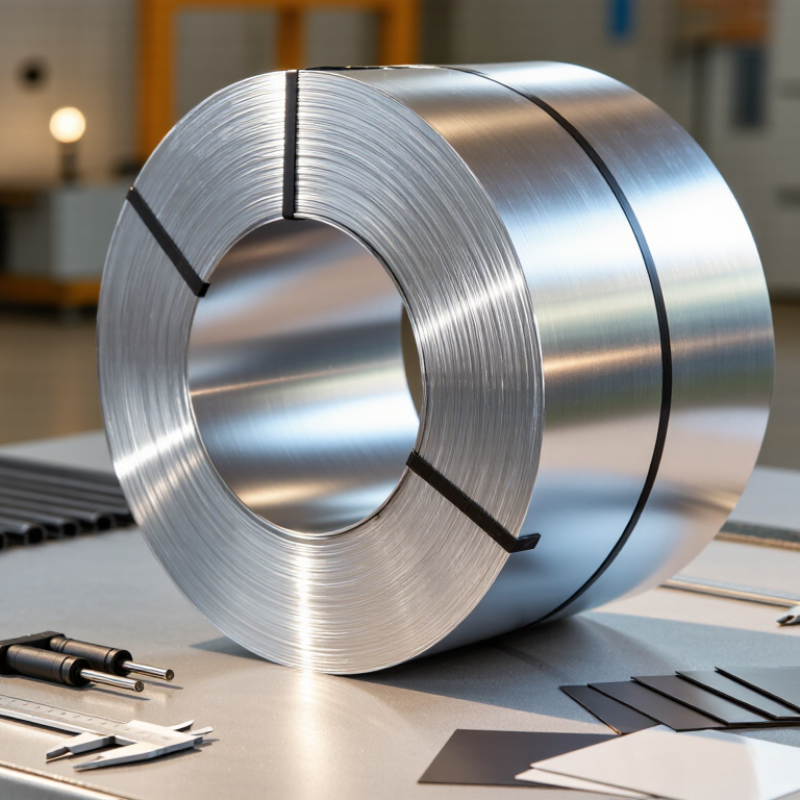
Define Steel Type: Type 1 Uses 90% Al–10% Si; Type 2 Uses Pure Al
7 Tips for Buying Aluminized Steel Coil
Define the steel type before comparing prices. Type 1 aluminized steel uses a coating of about 90% aluminum and 10% silicon. The silicon helps control the coating interface during hot-dip processing. This structure supports strong adhesion and reliable forming in many fabricated parts. Type 1 is often considered for automotive components, exhaust systems, ovens, and other heat-exposed applications. Check the coating mass, steel grade, thickness, and forming requirements together. A low price can hide an unsuitable specification.
Type 2 uses commercially pure aluminum in its coating. It provides a bright surface and strong resistance to atmospheric corrosion. Many buyers select it for roofing, siding, ducts, and general outdoor panels. However, pure aluminum coatings may respond differently during bending, cutting, and joining. Ask for test data on edge protection and coating adhesion. Small details matter.
Measure twice.
A practical buying mistake is focusing only on aluminum percentage. I have seen specifications that ignored substrate strength and coil flatness. That choice created avoidable forming problems later. Review the mill certificate, coating uniformity, surface finish, coil weight, and slit-edge quality. Confirm the intended service temperature as well. Type 1 may suit demanding heat exposure, while Type 2 may better match visible architectural surfaces. The right choice depends on the complete design, not one label. If the application is unclear, request sample testing before ordering a full coil.
Verify ASTM A463 Grade, Yield Strength, and 0.20–3.2 mm Thickness
7 Tips for Buying Aluminized Steel Coil
Verify ASTM A463 Grade, Yield Strength, and 0.20–3.2 mm Thickness
Buying aluminized steel coil requires more than checking surface brightness. Start by confirming the ASTM A463 grade on the quotation and mill test report. Different grades support different forming, welding, and structural requirements. Do not assume that every A463 coil has identical mechanical properties. Ask whether the material is Type 1 or Type 2 coated, because coating composition affects heat resistance and corrosion behavior.
Yield strength deserves careful attention. It can change with grade, thickness, rolling direction, and processing condition. Request the specified minimum value in MPa, along with tensile strength and elongation. Check the test direction and lot number. A report without traceable heat information feels incomplete. It may still look professional.
Thickness should match the actual application, not only the catalog range. For coils between 0.20 and 3.2 mm, confirm whether the stated measurement includes the aluminum coating. Many suppliers list base-metal thickness, while others describe total coated thickness. Measure several points across the strip with a calibrated micrometer. Edges and coil ends can reveal variation. Small errors matter during stamping.
Review width tolerance, flatness, coating mass, and surface condition before payment. A clean sample is useful, but one sample cannot represent an entire coil. Request production records and independent inspection when tolerances are tight. I would also compare the certificate with the packing label. Mismatched numbers are a warning. Sometimes the overlooked detail causes the expensive problem.
Compare Coating Mass: AZ50–AZ55 Equals About 150–185 g/m²
7 Tips for Buying Aluminized Steel Coil
Compare Coating Mass: AZ50–AZ55 Equals About 150–185 g/m²
Coating mass deserves careful attention when buying coated steel coil. However, AZ50–AZ55 usually refers to an aluminum-zinc coating designation, not 150–185 g/m². In many specifications, AZ50 means approximately 50 g/m² across both sides, while AZ55 means about 55 g/m². The exact meaning can vary by standard, supplier, and testing method. Ask for the governing specification before comparing prices.
A quoted range of 150–185 g/m² may describe another coating system, a one-sided measurement, or a different trade designation. Do not compare numbers blindly. Request the coating mass per side and for both sides. Check whether the value is nominal or guaranteed minimum. A mill test certificate should identify the substrate thickness, coating type, test method, and measured results. Small details matter.
Inspect the coil edges and surface. Look for uneven coating, bare spots, scratches, or trapped moisture marks. A heavier coating does not automatically provide better performance. Forming, cutting, storage, and the service environment also influence durability. I have seen buyers focus on one impressive number and overlook edge protection. That choice can create problems later. A simple laboratory verification may be worthwhile when the order is large. If the quotation says “AZ50–AZ55 equals 150–185 g/m²,” request clarification in writing before approval. The wording may be correct for a specific system, but it should never remain ambiguous.
7 Tips for Buying Aluminized Steel Coil - Compare Coating Mass: AZ50–AZ55 Equals About 150–185 g/m²
Specification note: In ASTM A792/A792M terminology, AZ50 and AZ55 refer to a minimum coating mass of approximately 0.50 and 0.55 oz/ft², respectively, on both sides combined. This converts to about 153 and 168 g/m². A value near 185 g/m² is closer to AZ60, so the applicable standard and test basis should always be confirmed.
| Tip | Buying Dimension | What to Compare | Practical Check |
| 1 | Coating Mass | AZ50: 0.50 oz/ft² ≈ 153 g/m² total both sides
AZ55: 0.55 oz/ft² ≈ 168 g/m² total both sides
AZ60: 0.60 oz/ft² ≈ 183 g/m² total both sides | Confirm whether the quoted value is total coating mass for both surfaces or coating mass per side. Do not treat AZ50–AZ55 as automatically equal to 185 g/m². |
| 2 | Base Steel Grade | Commercial quality, forming quality, structural quality, or another specified grade | Match yield strength, tensile strength, elongation, and forming requirements to the intended application instead of selecting only by coating mass. |
| 3 | Steel Thickness | Specify the nominal thickness and permitted thickness tolerance; state whether the measurement includes the coating | Request the measurement method and confirm whether thickness is measured on the bare steel or on the finished coated product. |
| 4 | Coating Composition | Aluminum-zinc alloy coating with silicon; the exact chemistry should follow the applicable product standard | Ask for the material specification, coating chemistry, and certificate of analysis when corrosion performance or welding behavior is critical. |
| 5 | Surface Finish and Treatment | Surface appearance, passivation or chemical treatment, oiling, and suitability for painting | Confirm whether the surface is intended for exposed use, roll forming, adhesive bonding, or post-painting. |
| 6 | Coil Dimensions and Shape | Width, inside diameter, outside diameter, coil weight, edge condition, flatness, and camber | Check that the coil dimensions fit the decoiler and production line. Define maximum coil weight and acceptable edge defects before ordering. |
| 7 | Inspection and Documentation | Coating-mass test results, mechanical properties, dimensional inspection, visual inspection, and traceability | Require a material test report identifying the applicable standard, heat or coil number, coating designation, dimensions, and test results. |
Conversion reference: 1 oz/ft² ≈ 305.15 g/m². Therefore, AZ50 ≈ 152.6 g/m², AZ55 ≈ 167.8 g/m², and AZ60 ≈ 183.1 g/m². Actual acceptance values depend on the specified standard, test method, and sampling requirement.
Check Coil Dimensions, Flatness, Weldability, and Surface Quality
7 Tips for Buying Aluminized Steel Coil
Check the coil’s thickness, width, inner diameter, and outer diameter before ordering. Small dimensional errors can disrupt forming and slitting operations. Ask for measured tolerances, not only nominal values. Confirm the coating weight and steel grade on the material certificate. Flatness also matters. Place a sample on a level table and inspect edge waves, center buckles, and coil set. A straightedge can reveal problems that photographs hide. I have seen acceptable-looking coils create feeding trouble after uncoiling.
Weldability deserves a practical test. Request information about the base steel, coating type, and recommended welding range. Aluminized coatings may affect resistance welding, heat input, and electrode wear. Run trial welds using the intended equipment whenever possible. Check bead appearance, penetration, spatter, and joint strength. Keep the test simple. A perfect laboratory result may not match a busy production line. This is where buyers sometimes rely too heavily on paperwork.
Surface quality should be checked under clear, consistent lighting. Look for scratches, stains, black spots, bare areas, dents, and coating cracks. Light discoloration may be cosmetic, but corrosion marks need investigation. Define acceptable limits before shipment. Request inspection records, coil photographs, and traceable heat numbers. Packaging should protect edges from moisture and impact. Do not ignore the smell or condition inside the wrapping. It may indicate storage problems. My own checklist has changed after overlooking one minor edge dent that later expanded during forming.
Assess Mill Certificates, Sampling Tests, Lead Time, and Total Cost
7 Tips for Buying Aluminized Steel Coil
Buying aluminized steel coil requires more than comparing quoted prices. Request a complete mill certificate for every production lot. Check steel grade, coating type, coating mass, thickness tolerance, width tolerance, and mechanical properties. Confirm the certificate matches the coil number on the shipping documents. Small mismatches can create serious traceability problems. Ask whether testing follows recognized standards and whether an independent laboratory can verify disputed results. Do not rely on a certificate that lacks test dates, methods, or measured values.
Sampling tests should reflect your actual process. Inspect coating coverage, surface defects, edge condition, flatness, and dimensional accuracy. Test samples from different coil positions when possible. One sample may hide variation. Lead time also needs careful examination. Ask about production scheduling, inspection time, packing, export documents, and port handling. A short factory estimate may not reflect the real delivery window. Build a practical buffer. Delays happen.
Total cost includes more than material price. Add testing, slitting, protective packaging, freight, insurance, duties, storage, and possible scrap. Compare cost per usable tonne, not cost per shipped tonne. Clarify payment terms and replacement procedures before ordering. I would also record every acceptance requirement in the purchase contract. This step feels tedious. It prevents expensive arguments later. Review your assumptions after the first shipment, because real yield may differ from the supplier’s estimate.
7 Tips for Buying Aluminized Steel Coil: Assess Mill Certificates, Sampling Tests, Lead Time, and Total Cost
How to use this chart: ASTM A463/A463M coating designations are associated with minimum total coating weights applied to both sides of the steel sheet. Confirm the specified designation on the mill certificate, verify it through representative sampling tests, and compare coating requirements with lead time, processing needs, freight, and total delivered cost.
Purchasing note: A higher coating designation generally means greater aluminum coating coverage, but the correct selection should also consider forming requirements, corrosion exposure, thickness tolerance, inspection results, delivery schedule, and lifecycle cost.