
Choosing the right Solar Panel Gasket is a small decision with a long service life behind it. A gasket sits quietly between the module, frame, and mounting components. Yet it faces rain, ultraviolet exposure, dust, heat, cold, and repeated thermal expansion. One weak seal can allow moisture to enter. That moisture may corrode metal contacts or reduce module reliability.
Dr. Elena Marquez, a solar module sealing specialist, explains, “A gasket must protect the panel without creating new mechanical stress.” Her point deserves attention. The softest material is not automatically the best choice. A gasket must match the panel design, frame geometry, compression level, and installation environment. Silicone may perform well under sunlight and temperature changes. EPDM can offer strong weather resistance and practical cost control. However, material names alone cannot guarantee performance.
Look closely at the details. Is the gasket evenly compressed? Does it recover after long-term pressure? Can it tolerate the local temperature range? Does its width fit the aluminum channel without twisting? These questions matter more than attractive product photographs.
Some buyers focus only on price. That approach can fail. A cheaper gasket may shrink, harden, or lose contact after years outdoors. Still, no selection method is perfect. Installation quality, storage conditions, and panel design can change the result. Even an excellent Solar Panel Gasket can perform poorly when cut incorrectly or forced into a contaminated groove.
The right choice requires testing, dimensional checks, and honest attention to the installation site. Small detail. Big consequence.
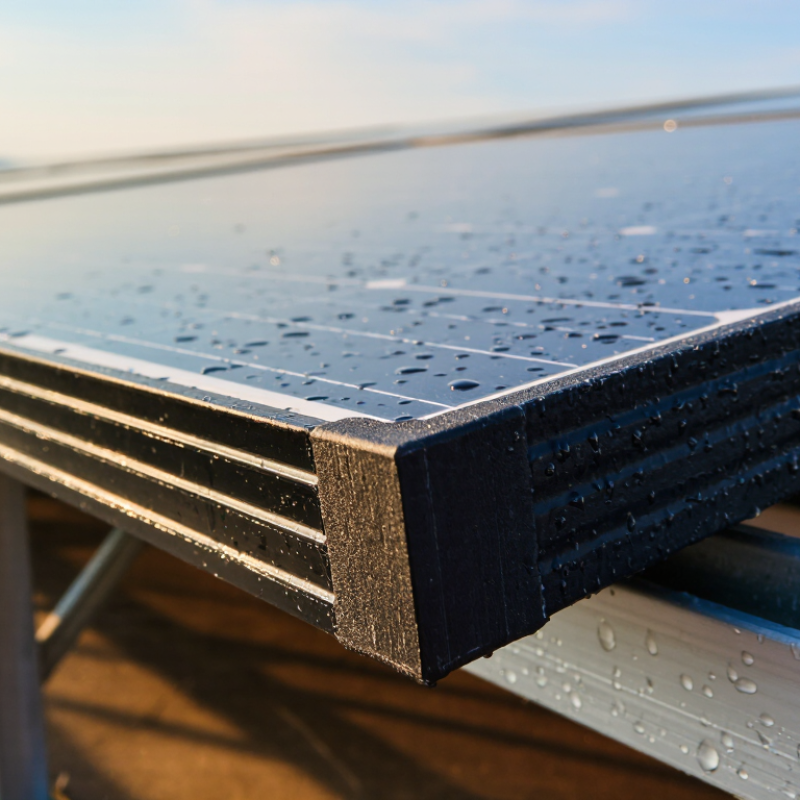
How to Choose the Right Solar Panel Gasket?
A solar panel gasket forms a flexible barrier between the frame, glass, and backing structure. Its main job is to block rain, dust, and humid air from entering the module. It also absorbs small movements caused by wind, vibration, and daily temperature changes. Without proper compression, even an excellent gasket can leak. Small gaps matter.
Material selection deserves careful attention. EPDM usually offers strong resistance to ultraviolet exposure, ozone, and changing weather. Silicone performs well across wide temperature ranges and remains flexible for years. Neoprene can resist oils and moderate weathering, but it may not suit every outdoor installation. Check the material’s temperature range, hardness, compression recovery, and chemical compatibility. A softer gasket is not always better. It can deform under pressure.
Measure the channel accurately before ordering. The gasket should fit firmly without excessive stretching or twisting. Inspect corners, joints, and cut ends during installation. These areas often fail before the straight sections. Field checks should include visual inspection and controlled water testing. Do not rely on appearance alone. I have seen clean, neatly fitted seals fail after repeated thermal cycling. No gasket is perfect. Installation pressure, surface cleanliness, and frame design can change its service life. A careful choice considers the whole sealing system, not just the rubber profile.
| Selection Dimension | Recommended Specification or Material | Typical Data or Performance Range | Why It Matters for Solar Panels |
|---|---|---|---|
| Primary Function | Weather sealing, cushioning, vibration reduction, and electrical isolation | Continuous sealing around frames, glass edges, junction boxes, and cable-entry points | A gasket helps prevent water, dust, insects, and condensation from reaching sensitive components. |
| Common Material | EPDM rubber | Good resistance to ultraviolet radiation, ozone, moisture, and outdoor weathering | A practical general-purpose choice for exterior solar-panel sealing applications. |
| High-Temperature Material | Silicone rubber | Often suitable for approximately −50°C to 200°C, depending on formulation and certification | Useful where panels experience high temperatures, strong sunlight, or large thermal cycling. |
| Flexible Thermoplastic Option | TPE or TPV | Good flexibility and processability; temperature and weathering performance depend on grade | Can support custom profiles, efficient extrusion, and recyclable production workflows. |
| Material to Use with Caution | Natural rubber or general-purpose rubber | Outdoor durability varies and may be lower under prolonged UV, ozone, and heat exposure | These materials may harden, crack, or lose elasticity sooner if not specifically formulated for outdoor use. |
| Operating Temperature | Select a grade rated above the expected minimum and maximum temperatures | Outdoor systems may experience approximately −40°C to 85°C or higher at exposed surfaces | Adequate temperature margin helps prevent brittleness, softening, shrinkage, and loss of sealing pressure. |
| UV and Ozone Resistance | EPDM, silicone, or UV-stabilized TPE | Should be verified through the material grade and relevant weathering tests | Solar gaskets are continuously exposed to sunlight and atmospheric ozone, which can degrade unsuitable elastomers. |
| Hardness | Typically 60–80 Shore A for many frame and edge-sealing profiles | The exact value depends on groove geometry, compression, and required flexibility | Softer materials conform well to irregularities; harder materials can provide stronger support but need accurate dimensions. |
| Compression Ratio | Use the profile manufacturer’s design recommendation; avoid over-compression | Many rubber sealing profiles operate around 15%–30% compression, depending on design | Insufficient compression may leak, while excessive compression can cause installation damage and permanent deformation. |
| Compression Set | Choose a low-compression-set grade for long-term sealing | Compare test results at the intended temperature and exposure duration | Low compression set helps the gasket retain sealing force after years of clamping and thermal cycling. |
| Water and Dust Protection | Closed-cell or properly compressed elastomeric sealing profile | Protection level depends on the complete enclosure design, joints, drainage, and installation quality | A gasket alone does not determine ingress protection; the assembled system must be tested as a whole. |
| Chemical Compatibility | Check compatibility with cleaning agents, sealants, adhesives, oils, and mounting materials | EPDM generally performs well with water-based fluids but has limited resistance to petroleum oils; silicone compatibility varies | Chemical attack can cause swelling, softening, cracking, or loss of adhesion. |
| Electrical Insulation | Electrically insulating, non-conductive elastomer | Verify dielectric strength, volume resistivity, and applicable photovoltaic safety requirements | The gasket should not create an unintended conductive path near energized components. |
| Profile and Dimensions | Match the groove width, depth, corner radius, glass thickness, and frame geometry | Dimensional tolerances should be confirmed by drawings or sample fitting | Even a high-quality material may leak if the profile is too large, too small, or incorrectly fitted. |
| Installation Method | Dry-fit, press-fit, adhesive-backed, or mechanically retained profile | Allow for thermal expansion and avoid stretching the gasket during installation | Stretching, twisting, sharp bends, and contaminated surfaces can create gaps and premature failure. |
| Environmental Exposure | Select for the site climate: coastal, desert, high-altitude, humid, snowy, or industrial | Consider salt spray, sand abrasion, freeze–thaw cycles, humidity, and pollutants | The correct material depends on the actual installation environment, not only on the panel location. |
| Testing and Compliance | Request material datasheets, aging data, dimensional inspection, and relevant photovoltaic test evidence | Tests may include UV aging, heat aging, ozone exposure, compression set, flammability, and water ingress | Independent test data is more reliable than a material name or an unverified service-life claim. |
| Recommended Selection Priority | Compatibility first, dimensions second, installation and cost third | Confirm material, temperature, weathering, compression, profile, and test requirements before ordering | A lower initial price is not beneficial if the gasket causes leakage, corrosion, or repeated maintenance. |
Note: Performance values are typical industry ranges and can vary with formulation, profile design, installation method, and test conditions. Always verify the material datasheet and project-specific requirements before final selection.