
Choosing a reliable Floor Drain manufacturer in China requires more than comparing unit prices. Global buyers need proven materials, stable production, accurate dimensions, and responsive technical support. A drain may look simple, yet its performance depends on slope, water sealing, grating strength, and installation tolerance.
Richard Trethewey, a licensed master plumber and plumbing expert, has often stressed a practical point: “A drain is only as reliable as the installation around it.” This view matters when evaluating Chinese suppliers. Experienced manufacturers should explain how their Floor Drain designs manage odor, hair, debris, and standing water. They should also provide product drawings, material details, testing records, and clear packaging specifications.
Look closely at the factory process. A serious supplier can show stainless steel forming, welding, polishing, passivation, and leak testing. Samples should match mass production. Not always perfectly. That is where careful buyers must ask harder questions.
Some factories offer 304 stainless steel as standard, while others provide 316 for demanding coastal or chemical environments. Surface finish also affects maintenance and appearance. A poorly aligned grate can create noise, puddles, or an uneven walking surface. Small errors become expensive on large projects.
The best China Floor Drain manufacturers support OEM development, private labeling, and export documentation. They understand that a bathroom project in Dubai may need different drainage details from one in Germany or Canada. Certifications help, but they do not replace inspection. Factory audits, sample approval, and pre-shipment checks remain valuable.
This guide examines leading manufacturers for global buyers. It also considers a less comfortable truth: the cheapest quote may hide the highest installation risk. Reliability deserves a measured decision.
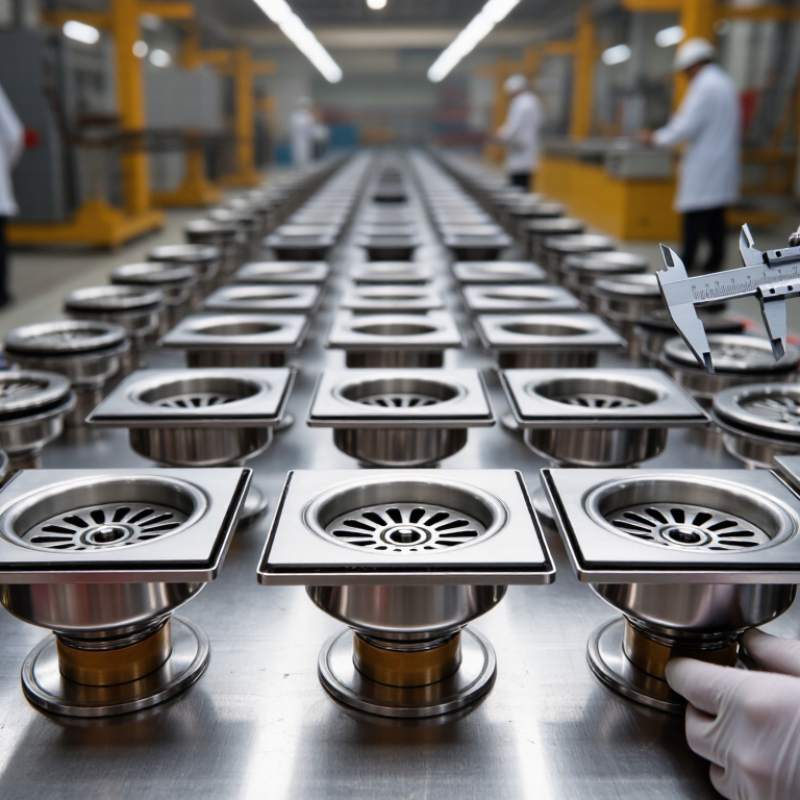
Chinese manufacturers offer several floor-drain types for global residential, commercial, and hospitality projects. Point drains remain common in bathrooms, with square or round grates and adjustable height frames. Linear drains suit walk-in showers because they create a cleaner floor layout. Tile-insert models hide beneath matching ceramic surfaces. Some factories also produce balcony drains, washing-machine drains, and heavy-duty trench drains for kitchens or public buildings.
The WHO and UNICEF Joint Monitoring Programme reported that 3.5 billion people lacked safely managed sanitation in 2022. This figure shows the scale of infrastructure demand, although it does not measure floor-drain sales directly. China’s National Bureau of Statistics recorded a 66.16% urbanization rate at the end of 2023. That growth supports demand for efficient drainage components in new housing and renovation projects. Chinese suppliers commonly use stainless steel, brass, ABS, or cast materials. Buyers should check corrosion resistance, outlet size, water-seal depth, and flow-test records. Anti-odor drains often use deep water traps or mechanical membranes. Mechanical seals can perform well, but maintenance requirements are easy to underestimate. CE, EN 1253, or local compliance documents may support project approval, but certificates need verification. Drainage rate claims also require testing under comparable conditions. The model with the largest outlet is not always the best choice. Tile thickness, slope accuracy, and cleaning access still decide installation results.
For global buyers, floor drain material determines service life more than appearance. Stainless steel 304 suits most indoor bathrooms and commercial kitchens. Stainless steel 316 offers stronger resistance in coastal, chemical, and high-humidity areas. Brass provides good strength, but its surface finish and alloy composition require careful inspection. ABS and other engineering plastics reduce cost and weight. They may perform well where temperatures and mechanical loads remain moderate.
Manufacturers should control more than raw materials. Drain bodies need accurate dimensions, smooth internal channels, and reliable welding or molding. A small height error can leave water around the grate. Poorly finished welds may collect dirt and weaken corrosion resistance. Practical factories test water flow, leakage, grate loading, and seal performance before shipment. They should also keep batch records and material certificates. These documents help buyers verify consistency instead of trusting polished samples alone.
Relevant requirements may include EN 1253, ASME A112.6.3, or local plumbing standards, depending on the destination. Compliance is not automatically global. A drain approved for one market may still need different testing elsewhere. Buyers should confirm outlet size, odor-trap design, surface treatment, and installation depth with the project engineer. In my experience, many failures begin with an unclear drawing. That detail deserves more attention. Even experienced teams sometimes overlook cleaning access or future replacement needs.
The chart shows the nominal load classes defined in EN 1253-1 for drainage products, expressed in kilonewtons (kN). H1.5 and K3 are generally associated with light-duty areas, while L15, M125, N300 and R600 represent progressively higher load requirements. Stainless steel grades such as 304 and 316, cast iron, and coated steel are commonly selected according to corrosion exposure, hygiene requirements, traffic loading and installation environment. Actual product performance should be verified through the manufacturer’s test reports and applicable regional standards.
Reference: EN 1253-1 load classification for gullies and floor drains. Load class selection must be confirmed for the intended application.
China Top Floor Drain Manufacturers for Global Buyers
Evaluating China-based floor drain suppliers requires more than comparing catalog prices. Start with material evidence. Ask for stainless steel grade reports, dimensional drawings, load-test results, and surface-finish records. For wet rooms, check water-seal depth and flow capacity under realistic debris conditions. A drain that performs well in a clean showroom may fail beside a construction site.
Quality systems matter, but certificates are not proof of every shipment. The ISO Survey 2023 recorded more than 1.2 million ISO 9001 certificates worldwide, so certification alone cannot separate strong suppliers from weak ones. Request the certificate number, issuing body, and recent audit scope. Then compare those details with factory records. Keep samples from approved batches.
Check production capability directly. Ask how welding distortion is controlled, how grates are inspected, and where final testing occurs. A useful audit includes random carton opening, gauge measurement, and a practical drainage test. The World Bank’s Logistics Performance Index 2023 gave China a score of 3.7, reflecting strong logistics capacity, but transport performance does not guarantee product consistency. Review export history through UN Comtrade or customs data, using the correct sanitary-ware classification. Classification can be imperfect. That is worth admitting. Finally, confirm packaging strength, spare-part access, inspection responsibility, and written remedies for nonconforming goods before placing a large order.
| Evaluation Dimension | What Global Buyers Should Check | Relevant Technical Data or Benchmark | Recommended Supplier Evidence | Evaluation Priority |
|---|---|---|---|---|
| Product Material | Confirm the stainless-steel grade, surface finish, and corrosion resistance required for the installation environment. | Common grades include SUS 304 for general indoor use and SUS 316/316L for higher chloride or coastal exposure. Typical decorative finishes include brushed, polished, and PVD-coated surfaces. | Material certificate, grade identification, surface-finish sample, and independent composition test when required. | High |
| Drainage Capacity | Compare flow performance at the same test conditions rather than relying only on outlet diameter. | Flow rate depends on grate design, outlet size, trap configuration, head of water, and installation conditions. Request test results stated in L/min under defined conditions. | Flow-test report showing test setup, water head, outlet size, measured flow, and test date. | High |
| Outlet Compatibility | Ensure the outlet and connection method match the destination market’s drainage system. | Frequently specified outlet sizes include DN50, DN75, and DN100. Threaded, solvent-weld, push-fit, and spigot connections may have different regional requirements. | Dimensioned drawings, tolerances, connection standard, and physical sample for fit testing. | High |
| Odor and Pest Protection | Assess whether the drain uses a water trap, dry trap, membrane, or mechanical sealing system. | Water-seal depth, evaporation resistance, debris tolerance, and cleaning access should be verified according to the applicable project specification and standard. | Section drawings, seal-depth data, odor-blocking test results, and maintenance instructions. | High |
| Load Resistance | Match the grate and frame load rating to the location, including residential, commercial, industrial, or pedestrian areas. | EN 1253-1 uses load classes such as K3, L15, and M125 for different installation areas. The applicable class must be selected according to the project location. | Load-class declaration, test report, loading diagram, and installation limitations. | High |
| Dimensional Accuracy | Check grate dimensions, frame squareness, outlet alignment, height adjustment, and tile-insert tolerances. | Critical dimensions should be controlled against approved drawings. Tolerances must be stated clearly rather than described only as “standard size.” | Approved engineering drawing, inspection plan, sample measurement record, and first-article inspection report. | High |
| Waterproofing Integration | Review the flange, clamping ring, bonding surface, and compatibility with the project waterproofing system. | The drain should provide a continuous, secure interface with the membrane or wet-room system used on site. | Installation cross-section, compatible sealant or membrane list, and waterproofing test procedure. | High |
| Manufacturing Capability | Distinguish between a manufacturer with controlled production and a trading company using multiple subcontractors. | Review stamping, casting, welding, machining, polishing, coating, assembly, and final inspection capabilities relevant to the product. | Factory audit, production-flow photographs or video, equipment list, process-control records, and sample traceability. | High |
| Quality Management | Verify whether quality procedures cover incoming materials, in-process inspection, final inspection, and corrective actions. | ISO 9001 certification can indicate a quality-management system, but it does not by itself prove product performance or compliance with every market standard. | Current certificate, certification scope, inspection checklist, nonconformity records, and corrective-action procedure. | High |
| Testing and Compliance | Identify the standards and building-code requirements that apply in the destination country. | EN 1253 is widely referenced for gullies and floor drains in European projects. Other markets may require national plumbing, drainage, or building-code compliance. | Third-party test reports, declaration of conformity where applicable, standard edition, laboratory accreditation, and product scope. | High |
| Customization Capacity | Evaluate the ability to modify dimensions, grate patterns, finishes, packaging, and installation accessories. | Confirm tooling ownership, prototype process, minimum order quantity, tooling charges, sample lead time, and approval stages. | Customization quotation, prototype sample, tooling agreement, approved drawing, and change-control procedure. | Medium |
| Packaging and Logistics | Check protection against scratches, deformation, moisture, and mixed-model shipment errors. | Packaging should identify product code, quantity, batch or lot information, country of origin, and handling requirements where applicable. | Packaging specification, carton-drop test if required, pallet plan, packing list, and export documentation samples. | Medium |
| Commercial Transparency | Compare total landed cost instead of unit price alone. | The comparison should include tooling, testing, packaging, inland transport, export documents, freight, duties, inspection, and after-sales costs. | Itemized quotation, Incoterms® 2020 term, payment schedule, validity period, tooling ownership, and warranty terms. | Medium |
| Supplier Verification | Confirm the legal identity, registered business scope, production address, and export capability before placing an order. | The legal entity shown on the quotation, contract, bank account, certificates, and shipping documents should be consistent. | Business registration information, factory audit, certificate verification, bank-account confirmation, and pre-shipment inspection. | High |
Quality control matters more than a polished catalog image. The WHO/UNICEF JMP 2023 report estimates that 3.5 billion people lacked safely managed sanitation in 2022. Small drainage failures can therefore create serious hygiene risks. Reliable manufacturers should verify stainless steel thickness, outlet dimensions, water-seal depth, and welding consistency. Each batch needs traceable inspection records. Critical tests include flow performance, leakage resistance, load capacity, and surface corrosion exposure.
Customization should begin with site conditions, not appearance. Global buyers may require 50, 75, or 110 millimeter outlets, removable odor traps, hair filters, tile-insert covers, or adjustable frames. Products should match applicable standards, such as EN 1253 or ASME A112.6.3, where relevant. Factory drawings must show tolerances clearly. A two-millimeter mismatch can delay installation. Finish samples also need verification under actual cleaning chemicals and humidity.
Third-party testing adds useful confidence, but it is not a perfect shield. A sample may pass while later batches vary. Buyers should request pre-shipment photographs, material certificates, inspection plans, and random production checks. Packaging deserves attention too. Bent grates and damaged threads often appear after transport. The better question is not, “Can this drain be customized?” It is, “Can every customized unit remain consistent?”
China remains a major sourcing base for stainless steel and brass drainage components. UN Comtrade data for HS 732490 offers a useful trade proxy, although it does not isolate floor drains. Buyers should treat the numbers carefully. Product classification can distort comparisons.
Export readiness begins with documentation. Ask for commercial invoices, packing lists, certificates of origin, and verified test reports. EN 1253 is relevant for many European drainage applications. ASME A112.6.3 may matter in North American projects. Requirements vary by destination. CE marking applies only where relevant legislation and harmonized standards cover the product. A logo alone proves little.
Check the details.
Independent testing should confirm flow rate, water-seal depth, load performance, corrosion resistance, and leak prevention. Stainless steel grade must be stated clearly, such as 304 or 316, not simply “premium steel.” ISO Survey data shows the continued global use of ISO 9001 quality systems, but certification does not replace product testing. Review the certificate scope, issuing body, and expiry date.
Purchase decisions also need practical evidence. Request samples with removable hair baskets, measured outlet diameters, and installation drawings. Confirm carton dimensions before booking freight; drains often waste space through poor packing.
Factory audits can reveal welding marks, inconsistent polishing, or weak packaging. I have seen attractive samples hide unstable production controls. That risk deserves attention.
A lower unit price may become expensive after returns, retesting, and site delays.
Copyright © 2025 The Toolroom Inc. All Rights Reserved.
Website Design St Louis by IQComputing